
Deepfield Physics · Online · Years 10–12
University-level physics for students whose questions have outrun their classroom.
The Apprenticeship: a weekly live seminar, one-to-one mentoring and a research project of the student’s own, taught by a particle physicist. The first cohort starts with the school year on Tuesday 9 February 2027.
The sample lecture
Nobel Prize in Physics 2026: The IceCube Observatory and High-Energy Neutrinos
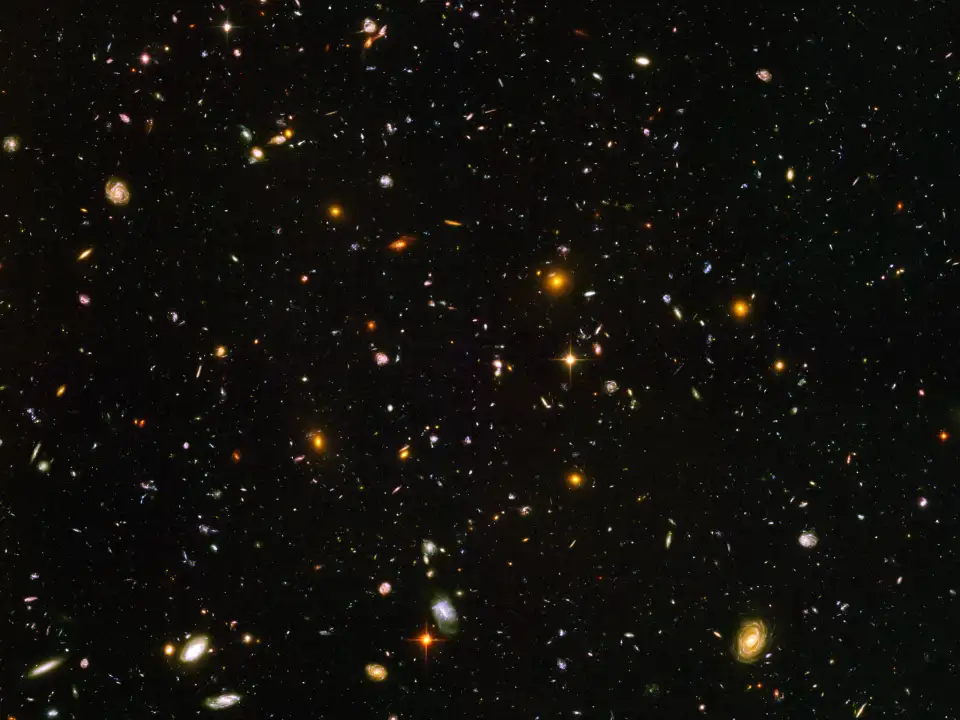 Deepfield Physics · LectureThe IceCube Observatory and High-Energy Neutrinos
Coming soon
The full recording goes up here shortly. Until then, the best way to see the level is a free live taster.
This is the level. See it live first.
Who it is for
Students who are ready for more.
Deepfield Physics is for Year 10–12 students in Australia who are well ahead of school physics. It asks for confident algebra, calculus begun or a willingness to learn it from the primers, and about four to five hours a week.
Three signs your child is ready
- 01Algebra is comfortable.Rearranging an equation is not the hard part of a problem.
- 02They have met calculus, or are ready to.A short maths primer goes out before each seminar, and the one-to-one sessions fill any gaps.
- 03They read ahead.Their questions go further than the class has reached.
How it works
A seminar, a mentor, a project, a publication.
Weekly seminar
An hour, live, every week. University-level ideas taught from first principles to a small group. Every seminar is recorded and shared with enrolled students.
One-to-one mentoring
Forty-five minutes with me every week, to fill gaps in the mathematics, go further than the seminar, and guide the project.
Research project
Each student carries out a guided individual project on real scientific data and presents it at the showcase that closes the program. See the fifteen projects.
The Deepfield Journal
Projects are published, with a parent’s consent, in the program’s own journal and archived with a permanent DOI. It is a program publication, not a peer-reviewed journal.
The Apprenticeship · Semester 1, 2027
Starts with the school year.
Sixteen weekly seminars through Terms 1 and 2, with one-to-one mentoring and a research project alongside. Students who hear about it after term starts can still join until week 4.
- Starts
- Tuesday 9 February 2027, the first full week of the NSW school year. Students can join until week 4 (Tuesday 2 March) and catch up from the recordings.
- Seminars
- 16 seminars, Tuesdays through Terms 1 and 2. No seminars in the April school holidays. · 6:30 pm Adelaide · 6:00 pm Brisbane · 5:30 pm Darwin · 4:00 pm Perth (from April: 7:00 pm Brisbane, 6:30 pm Darwin, 5:00 pm Perth). After school in every state, so everyone can join live; every seminar is also recorded.
- One-to-one
- 45 minutes every week, including the Easter project week: 17 in the semester.
- Curriculum
- Six topics, two or three seminars each, from classical mechanics to the Standard Model and how science knows what it knows. See the topics.
- Project
- A guided individual project on real scientific data, presented at the showcase at the end of Term 2 and published in the Deepfield Journal with a DOI. A program publication, not peer-reviewed.
- Group size
- A small group for the seminars; every student has their own weekly one-to-one.
- Time
- About 4 hours a week.
- Applications
- Apply by Friday 5 February to start in week 1. Final applications Friday 26 February.
Semester 2 follows in Terms 3 and 4, 2027. The Fellowship, for graduates of both semesters, takes its first intake in February 2028. Not ready this year? Join the waitlist for later intakes.
Semester 1 · Curriculum
Six topics, from Newton to the Standard Model.
Each topic takes one part of physics and builds it from first principles over two or three seminars, with the mathematics introduced as it is needed.
-
Topic 13 seminars
Introduction and classical physics
- Introduction and overview
- Forces and Newton’s laws
- Kinematic equations
- Energy conservation
-
Topic 22 seminars
Lagrangian mechanics
- Defining the Lagrangian
- Phase space of mechanical systems
- Chaos theory
- The principle of least action
-
Topic 33 seminars
Quantum mechanics
- From Lagrangian mechanics to quantum mechanics
- Wavefunctions, probabilities, measurement
- The uncertainty principle
- Quantisation and spectroscopy
-
Topic 42 seminars
Special relativity
- Galilean relativity
- Maxwell’s equations and the finite speed of light
- Time dilation, length contraction
- Spacetime interval, light cones
-
Topic 53 seminars
Particle physics
- Relativity and quantum mechanics together
- The Klein–Gordon and Dirac equations
- Reading the Standard Model Lagrangian
- History of the Standard Model particles
- Particle physics experiments
-
Topic 62 seminars
Philosophy of science
- The traditional scientific method
- Bayesian reasoning: updating on evidence
- Reproducibility and statistical significance
- Student presentations
Alongside the seminars: a one-to-one every week, a project week at Easter, and the showcase at the end of Term 2. See the project menu, and try one in your browser.
Free tasters
Try a session before you apply.
Two free live tasters run online: one just before the semester starts and one in its second week, for students who hear about it once school is back. Each runs about an hour; a notebook and pen are all that’s needed, and the recording goes to everyone registered.
-
Taster 1
Tue 19 January
6:30 pm Adelaide · 6:00 pm Brisbane · 5:30 pm Darwin · 4:00 pm Perth
-
Taster 2
Tue 2 February
6:30 pm Adelaide · 6:00 pm Brisbane · 5:30 pm Darwin · 4:00 pm Perth
Registration is by a parent or guardian.

Your mentor
Ben Carew
Particle physicist · Founder of Deepfield Physics
I am a particle physicist completing a PhD in neutrino physics at Sorbonne Université (LPNHE) in Paris, where I work on the Hyper-Kamiokande experiment. I teach every seminar and mentor every student myself.
Ten years ago, I read every science book I could find, but reading about the great theories of physics never made me feel any closer to doing real science myself. I built Deepfield to close that gap for my sixteen-year-old self.
- Doctorate
- PhD in neutrino physics, Sorbonne Université (LPNHE), Paris. In progress.
- Master’s
- International Masters in Advanced Methods in Particle Physics.
- Bachelor’s
- Bachelor of Advanced Science (Honours I, physics), University of Queensland.
- Research
- The Hyper-Kamiokande neutrino experiment.
- Teaching
- Five years as a presenter and team leader at Elevate Education; four years of private tutoring for Australian students; former director of the UQ science demo troupe.
What students say
“It’s helped me a lot, not only in improving my class skills, but also in what I want to work towards in my future. It has been an absolute blast to have you teach me such fun and amazing things.”
Child safety
Child-safety statement
Deepfield Physics is committed to the safety and wellbeing of every student.
- All live sessions are held on video with the parent’s knowledge of the time and link. Parents are welcome to observe any session.
- Seminars are recorded. One-to-one sessions are recorded and the recording is available to the student’s parent on request.
- All email goes to a parent’s address. There is no private messaging between the mentor and a student: project discussions happen in channels a parent can read.
- I hold a Queensland Working With Children Check, which expires in 2028.
- Students’ work, names and images are published only with a parent’s written consent.
- Concerns can be raised at any time by writing to [email protected]; a serious concern will be reported to the relevant authority.
Questions
Frequently asked
Who teaches?
I do. I am Ben Carew, a particle physicist completing my PhD in neutrino physics at Sorbonne Université in Paris and a member of the Hyper-Kamiokande experiment. I teach every seminar and mentor every student myself.
What level is it?
University-level ideas taught from first principles to students in Years 10–12. The sample lecture on the 2026 Nobel Prize in Physics shows the level.
Does my child need calculus?
They need confident algebra and an appetite for more. A short maths primer goes out before each seminar, and the one-to-one sessions fill any gaps.
Does it help with school exams?
It is not exam preparation. Students usually find school physics easier afterwards, but the aim is depth and research experience.
How much time does it take?
About four hours a week: a one-hour seminar, a 45-minute one-to-one, and problems or project work.
What if we miss a seminar?
Every seminar is recorded and shared with enrolled students.
Can my child join after the start?
Yes, until week 4 (Tuesday 2 March). They watch the recordings of the seminars they missed, and we catch up in their first one-to-one.
Is there a summer program?
Not this year. The first cohort starts with the school year in February; the free tasters in late January and early February are the best way to see the level first.
How do sessions work across time zones?
Seminars are on Tuesdays from 7:00 to 8:00 pm Sydney time. That is after school everywhere in Australia: 4:00 pm in Perth until April (then 5:00 pm), 6:00 pm in Brisbane (then 7:00 pm) and 6:30 pm in Adelaide. One-to-ones are booked at a time that suits each family. Every booking and calendar invitation shows your own local time.
Is it safe?
Sessions are by video, recorded, and open to parents; all correspondence goes through a parent. The full child-safety statement is on this page.
What is the Deepfield Journal?
The program’s own publication of student projects, archived with a permanent DOI. It is not a peer-reviewed journal.
What does it cost?
The fees are listed with Semester 1, 2027: A$3,600, or A$3,200 at the founding rate until 7 February, with a two-instalment option. For any other question about fees, write to me at [email protected] and I will reply personally.
Can a younger or older student join?
I decide case by case. Write to me at [email protected] with a few lines about your child.
Does it guarantee a university place or better grades?
No. I make no guarantee of university admission, grades or competition results. What the program offers is depth, research experience and a published project.
Apply · Semester 1, 2027
Apply for Semester 1.
Apply by Friday 5 February to start in week 1; final applications close Friday 26 February. Applications are made by a parent or guardian, and every reply goes to a parent’s address.
- Come to a free tasterA live online session, ideally together. It is the quickest way to judge the level.
- ApplyA short form about your child and what draws them to physics.
- A conversationFifteen minutes by video with me, for parent and student together.
- Confirm the placeA 25% deposit holds it; the balance is due by the date in the offer.
Or write to me directly: [email protected].